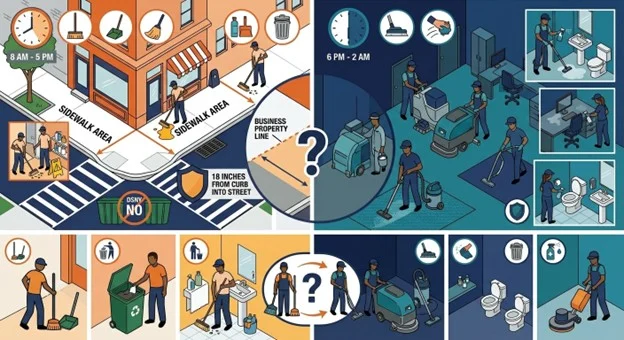
The difference comes down to when the work happens and what it is designed to accomplish. A janitorial crew resets your building after hours. A day porter keeps it presentable while people are in it. One is a nightly reset, the other is continuous upkeep, and they solve genuinely different problems.
Most facility managers we talk to in New York are not choosing between the two. They already have nightly janitorial and they are trying to figure out why the lobby still looks tired at 2 PM. This guide explains what each role actually covers, which building types need which, and how to tell when you have outgrown janitorial alone.
What a Janitorial Service Does
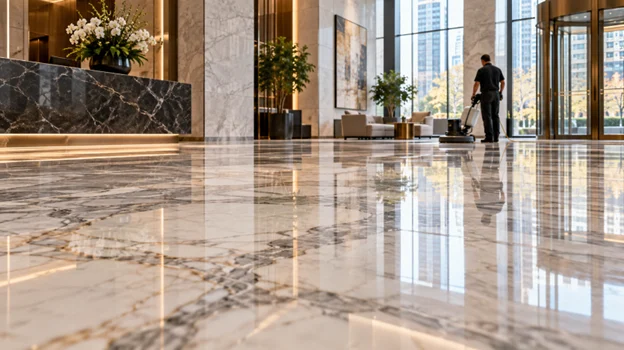
Janitorial work is scheduled, comprehensive, and almost always performed outside business hours. A crew arrives after the last employee leaves, works through a defined scope, and leaves the space reset for the next morning.
A typical nightly scope includes:
- Trash and recycling collection from every workstation, kitchen, and common area
- Restroom cleaning, disinfection, and consumable restocking
- Vacuuming carpet and dust or damp mopping hard floors
- Dusting horizontal surfaces, sills, and shared equipment
- Kitchen and breakroom wipe-down, including appliance exteriors
- Glass and entry door cleaning
- Periodic work on a cycle: floor stripping and waxing, carpet extraction, high dusting, and window cleaning
The strength of janitorial is thoroughness. Nobody is working around occupants, equipment can be moved, floors can be wet, and the crew can take the time to do the work properly. The limitation is equally obvious: everything janitorial accomplishes is finished by 6 AM and starts degrading the moment the doors open. If you want a fuller picture of what a nightly scope should cover, our guide to daily versus weekly janitorial schedules breaks down how frequency changes the outcome.
What a Day Porter Does
A day porter (sometimes called a matron, a building attendant, or simply porter service) is stationed at your facility during operating hours. The job is not to deep clean. It is to keep the building from ever visibly falling behind.
Day porter responsibilities usually include:
- Lobby and entrance upkeep, including glass, mats, and the exterior approach
- Restroom checks and restocking on a rotation through the day
- Spill and incident response within minutes rather than hours
- Trash pulls from high-traffic bins before they overflow
- Elevator cab and stairwell touch-ups
- Conference room and event turnover between meetings
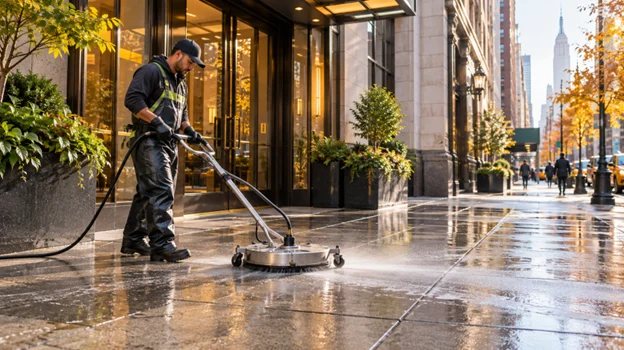
- Sidewalk sweeping and frontage checks
- Light maintenance support such as replacing a bulb or flagging a facility issue before it becomes a work order
The value of a porter is visibility and responsiveness. A restroom that runs out of paper at 10 AM is restocked at 10:05 instead of at 9 PM. A coffee spill in the lobby is gone before the 11 AM client meeting walks past it.
Day Porter vs. Janitorial Service: Side by Side
| Day porter | Janitorial service | |
|---|---|---|
| When | During business hours | After hours or overnight |
| Primary goal | Keep the building presentable in real time | Reset the building completely |
| Visibility to occupants | High, they are part of the environment | Low, occupants see the result not the work |
| Typical tasks | Restroom checks, lobby upkeep, spills, trash pulls, event turnover | Full clean of all areas, restroom disinfection, floors, periodics |
| Response time to an issue | Minutes | Next business day |
| Best for | High-traffic, customer-facing, or multi-tenant buildings | Every commercial facility, as the baseline |
| Can it replace the other? | No, it does not deep clean | No, it cannot respond during the day |
A Day in the Life of a Day Porter
To make the difference concrete, here is how porter coverage typically runs in a mid-size NYC office building:
- 7:30 AM. Sidewalk and entry check, mats straightened, lobby glass wiped, overnight debris cleared before the first arrivals.
- 9:30 AM. First restroom round. Restock, wipe counters, check for issues the night crew could not have predicted.
- 11:00 AM. Common area sweep. Elevator cabs, stairwell landings, high-touch surfaces.
- 12:30 PM. Lunch peak. Breakroom reset, trash pulls, spill response, kitchen wipe-down.
- 2:30 PM. Second restroom round, conference room turnovers, tenant requests.
- 4:30 PM. Final presentation pass so the building closes looking the way it opened, and a handoff note for the night janitorial crew.
That last handoff is the piece most buildings miss. When the porter and the night crew work for the same company, the porter flags what needs attention and the janitorial team addresses it that night. When they work for two different vendors, the information simply disappears.
| Not sure which coverage your building needs?
Greencap Cleaning provides day porter, matron, and full janitorial services across NYC, coordinated under one scope of work. Call (718) 687-4294 for a free walkthrough and a straight recommendation. |
Which One Does Your Building Need?
Office buildings and multi-tenant properties
Nightly janitorial is the baseline. Add a porter once you have shared restrooms serving more than roughly fifty people, a lobby that clients walk through, or multiple tenants whose complaints all land on the same property manager. Buildings under property management almost always justify porter hours, because the porter is also the person who catches the leak, the broken fixture, and the propped fire door.
Medical and healthcare facilities
Both, without much debate. Waiting rooms turn over constantly, restrooms see heavy use, and exam room turnover cannot wait until the evening. The nightly crew handles terminal cleaning and disinfection protocols. Our post on why medical offices require specialized janitorial services covers the compliance side in more depth.
Retail stores and shopping centers
Porter coverage is close to mandatory during trading hours. Fitting rooms, entry glass, and restrooms degrade fast under customer traffic, and a visibly dirty store measurably affects how long people stay. Retail and shopping center cleaning is typically structured as porter hours during the day plus a full nightly reset.
Banks, theaters, and venues
These are presentation-driven environments where the standard is not clean, it is immaculate at every moment a customer is present. Financial institutions and theaters and entertainment venues run porter coverage during operating hours as a matter of course.
Warehouses and light industrial
Usually janitorial only, unless you run a shift operation or maintain a customer-facing office and showroom at the front of the building. Break rooms in shift facilities are the exception that often justifies a part-time porter.
Schools, daycares, and houses of worship
Daytime coverage matters more than the square footage suggests, because restroom incidents, cafeteria spills, and event turnover all happen while the building is occupied and none of them can wait.
Signs You Have Enough Janitorial and Not Enough Porter
If more than two of these describe your building, the problem is not the quality of your nightly crew:
- Restrooms are out of supplies by mid-afternoon on a regular basis
- The building looks excellent at 8 AM and tired by 1 PM
- Complaints cluster in the afternoon and are always about common areas
- Spills sit until someone from your own staff deals with them
- Trash in high-traffic areas overflows before the evening pickup
- Conference rooms are not reset between back-to-back meetings
- Your own employees have quietly become the cleaning response team
- Entry glass and lobby mats never look right during business hours
Adding hours to the night crew will not fix any of these, because none of them are caused by insufficient nightly cleaning. They are caused by a gap in coverage that runs from 8 AM to 6 PM.
What Porter Coverage Costs
Day porter service is priced on staffed hours rather than square footage, which makes it one of the easier line items to control. Coverage scales in a straightforward way: a few hours a day at peak times, a half day, or a full-time stationed attendant.
Most buildings do not start with full-time coverage. They start with the four or five hours that span the lunch peak and the afternoon slump, then expand once they see the difference. If you are evaluating quotes, our guide to what to look for in a commercial cleaning contract explains how porter hours should be documented so you are not paying for coverage you do not receive.
The Hybrid Model Most NYC Buildings End Up With
After enough iterations, most well-run commercial properties in New York converge on the same structure. Nightly janitorial handles the full reset, restrooms, floors, and the periodic deep work on a defined cycle. Daytime porter hours handle presentation, restroom rounds, spills, and the constant small corrections that keep a busy building from ever looking neglected.
The efficiency comes from running both under one vendor and one scope of work. The porter sees what the night crew should prioritize. The night crew handles what the porter cannot do during occupied hours. Neither one is guessing, and you are not mediating between two companies. That coordination is also what makes janitorial services measurably improve workplace hygiene and productivity rather than simply checking a box.
Final Thoughts
Day porter and janitorial are not competing options. They are two halves of a complete program, and the question is not which one to buy but whether your building has enough daytime traffic to need both. Low-traffic offices and warehouses generally do not. Lobbies, retail floors, medical waiting rooms, and multi-tenant properties almost always do.
If your building looks great in the morning and worn out by mid-afternoon, you already have your answer.
Frequently Asked Questions
What is the difference between a day porter and a janitor?
A day porter works during business hours and focuses on keeping the building presentable in real time: restroom rounds, lobby upkeep, spill response, and trash pulls. A janitor typically works after hours and performs a complete cleaning of the facility, including restrooms, floors, and periodic deep cleaning. The difference is timing and purpose, not skill level.
Do I need both a day porter and a janitorial service?
If your building has heavy daytime foot traffic, shared restrooms serving a large population, a customer-facing lobby, or multiple tenants, you generally need both. Lower-traffic offices and warehouses are usually well served by nightly janitorial alone. A walkthrough at your busiest hour is the fastest way to tell.
What does a day porter do all day?
A day porter rotates through the building on a schedule: entry and lobby checks in the morning, restroom rounds every few hours with restocking, common area and elevator touch-ups, breakroom resets around lunch, conference room turnovers, and a final presentation pass before closing. They also respond immediately to spills and flag maintenance issues.
Is a day porter cheaper than adding more janitorial hours?
They are priced differently, so it is not a direct comparison. Porter service is billed on staffed hours during the day, while janitorial is typically priced by scope and square footage. More importantly, extra night hours cannot solve daytime problems, so the two are not interchangeable regardless of cost.
Can one company provide both services?
Yes, and it is generally the better arrangement. When the same company staffs both, the porter can flag issues directly for the night crew and the scope of work is coordinated rather than split across two vendors with separate reporting lines.
| Get the right coverage for your building.
Greencap Cleaning provides day porter, matron, and commercial cleaning services throughout New York City, in Brooklyn, Manhattan, Queens, the Bronx, and Staten Island. Call (718) 687-4294 or request a free quote. |