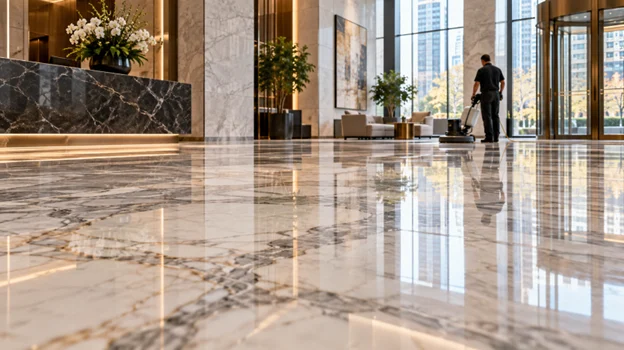
If your business occupies a storefront, an office lobby, or a warehouse loading door anywhere in the five boroughs, you are legally responsible for the sidewalk in front of your property and for 18 inches of the street beyond the curb. That obligation comes from the New York City Administrative Code, it applies seven days a week, and the Department of Sanitation does not need to see you make the mess in order to write the ticket.
Most sanitation summonses we see at Greencap are not the result of negligence. They are the result of a business owner who genuinely did not know that the gutter counts, that the tree pit counts, or that sweeping debris into a public litter basket is itself a violation. This guide walks through what the rules actually say, when inspectors are looking, and how to build a routine that keeps your frontage clean without anyone having to think about it.
The Short Answer: What Every NYC Business Must Do
Under NYC Administrative Code section 16-118, the owner or occupant of a property is required to keep the sidewalk and the adjacent gutter clean. The Department of Sanitation (DSNY) spells out what that covers:
- The full sidewalk width in front of your property, including tree pits, grass strips, and planted areas.
- 18 inches of the gutter measured from the curb into the street.
- Your storefront area, kept clear of debris, loose signage, and tripping hazards.
- Proper disposal of what you sweep up. Sweepings must go into your own bins with secure lids, not into a public DSNY litter basket.
That last point catches more businesses than any other. Public litter baskets are for pedestrian litter. Emptying a dustpan into one is treated as illegal dumping of commercial waste.
The 18-Inch Rule, Explained
The gutter requirement is the single most misunderstood rule in NYC commercial sanitation. Business owners assume the curb is the boundary of their responsibility. It is not. DSNY expects the strip of roadway running 18 inches out from the curb face to be as clean as the sidewalk itself.
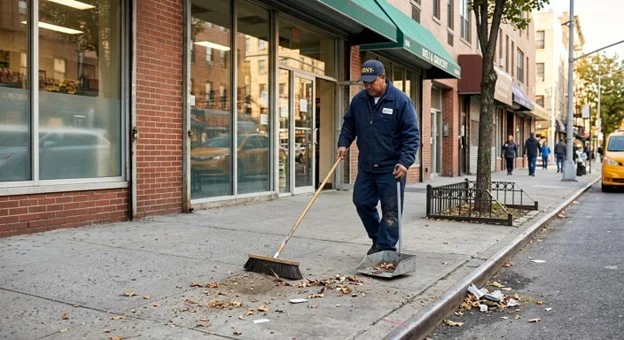
In practice, that means cigarette butts, food wrappers, leaf litter, and the sediment that collects against the curb line are all yours to remove. It also means you cannot simply sweep the sidewalk into the street and call it done. Pushing debris off the curb moves it from one area you are responsible for into another area you are responsible for, and an inspector who watches you do it can cite you twice.
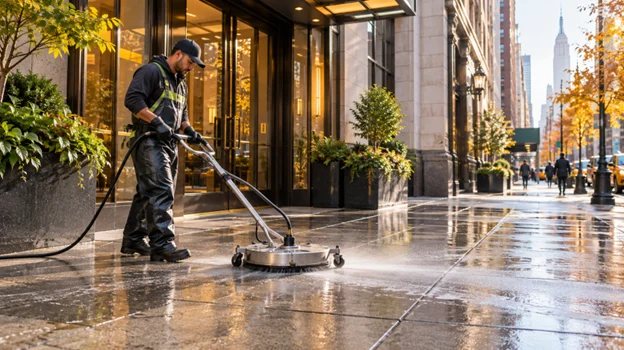
For frontages on busy retail corridors, this is where a scheduled commercial sidewalk and pressure washing service earns its keep. Sweeping handles loose debris. Ground-in grease, gum, and the dark staining that builds up outside food service doors need washing.
When DSNY Actually Inspects Your Sidewalk
Inspections are not random walk-bys. DSNY assigns each address two one-hour inspection windows per day, seven days a week. For residential properties those windows are published as 8:00 AM to 9:00 AM and 6:00 PM to 7:00 PM. For commercial properties the windows vary by address, which is exactly why the safe operating assumption is that your frontage should be clean at the start of the business day and clean again at the close of it.
Two sweeps a day sounds like a lot until you realize it is roughly ten minutes of work each time for a typical storefront. The businesses that get ticketed are almost always the ones relying on a single mid-afternoon pass, or on a porter who only comes twice a week.
If you have multiple locations across the boroughs, this is a coordination problem more than a cleaning problem. Our janitorial services teams build the open and close sweep into the daily scope so no location depends on someone remembering.
| Tired of guessing whether your frontage will pass?
Greencap Cleaning handles sidewalk sweeping, gutter clearing, and pressure washing for businesses across all five boroughs, on a schedule built around your inspection windows. Call (718) 687-4294 or request a free walkthrough. |
Snow and Ice: The Four-Foot Path Rule
Winter adds a separate obligation under Administrative Code section 16-123. After a snowfall ends, property owners must clear a path at least four feet wide across their sidewalk, and must also keep the area around fire hydrants, litter baskets, and corner pedestrian ramps clear.
The corner ramp requirement is the one that surprises people. If your building sits on a corner, the curb cut is part of your clearing responsibility, and a plowed-in ramp is both a citation risk and a real liability exposure if someone is injured trying to cross.
Timing matters as much as coverage. The clock starts when precipitation stops, and it runs differently depending on the hour the storm ends. Because those deadlines shift, the practical move for a commercial property is to have a service on standby rather than trying to interpret the window in the middle of a storm.
The Other Sanitation Rules That Ride Along
A DSNY inspector standing in front of your building is rarely looking at only one thing. These are the violations most commonly written alongside a dirty sidewalk citation:
| Violation | Code section | What is required |
|---|---|---|
| Dirty sidewalk or gutter | AC 16-118(2) | Sidewalk and 18 inches of gutter kept clean |
| Improper waste set-out | AC 16-120(c), (e) | Waste out within 2 hours of a daytime pickup, or within 1 hour of closing for a nighttime pickup, in securely tied bags or covered bins |
| No private carter posting | AC 16-116(b) | Carter sticker and pickup schedule posted and visible |
| Failure to recycle | 16 RCNY 1-10 | Source separation of cardboard, metal, glass, plastic, paper, and construction waste as applicable to your business type |
| Snow and ice not removed | AC 16-123 | Four-foot path, plus hydrants, baskets, and corner ramps cleared |
| Obstructions and tripping hazards | AC 16-118(2) | Storefront area kept clear of signage and debris |
Penalty amounts vary by violation and by whether it is a first or repeat offense. First offenses commonly start around $100, and several of these categories escalate into the $300 to $400 range. Confirm current amounts with DSNY or the Office of Administrative Trials and Hearings before relying on any figure.
Repeat Offenders and the Sidewalk Slobs List
DSNY has escalated enforcement against chronic violators through a public-facing campaign it calls Sidewalk Slobs, which pairs increased penalties with a published Hall of Shame naming repeat offenders. Fines for the worst repeat cases have been cited at up to $500.
For most businesses the fine is not the real cost. Being named publicly as the reason a block looks bad is a reputation problem, particularly for retail, restaurants, and any business whose customers walk past the frontage before they walk through the door. If you operate a retail store or shopping center in Brooklyn, the sidewalk is the first thing a customer evaluates, whether or not they know they are doing it.
How to Build a Sidewalk Routine That Passes
A frontage that consistently passes inspection follows the same pattern regardless of the business type:
- Sweep at open and at close. Full sidewalk width, tree pits included, then the 18 inches of gutter.
- Bag the sweepings on site. Into your own covered bin, tied, never into a public basket.
- Spot-check midday if you have food traffic. One pass at the lunch peak prevents the afternoon accumulation that inspectors see.
- Pressure wash on a cycle. Monthly for food service and high-traffic retail, quarterly for offices and light traffic.
- Keep the storefront zone clear. A-frames, pallets, and delivery debris are cited as obstructions.
- Have a winter plan before the first storm. Know who is clearing the four-foot path and the corner ramp, and how fast they can get there.
Property managers running multiple buildings usually fold all of this into one scope of work rather than managing it site by site. Our property management cleaning teams cover sidewalk maintenance alongside common areas, and our Brooklyn power washing crews handle the periodic deep cleans that sweeping cannot fix.
Final Thoughts
Sidewalk compliance in New York City is not complicated, but it is unforgiving. The rules are clear, the inspection windows are daily, and the responsibility sits with the property owner or occupant whether or not the litter was theirs. The businesses that never think about DSNY are simply the ones that built two short sweeps into the day and a washing cycle into the month.
If you are not sure whether your current routine covers the gutter, the tree pits, and the disposal rule, a walkthrough will tell you in ten minutes. It is a far cheaper way to find out than a summons.
Frequently Asked Questions
Who is responsible for cleaning the sidewalk in front of a business in NYC?
The property owner or the occupant of the premises is responsible under NYC Administrative Code section 16-118. In most commercial leases that obligation is passed to the tenant, so a storefront business is typically the party that receives the summons. Check your lease, but do not assume the landlord is handling it.
What is the 18-inch rule in New York City?
It refers to the gutter area extending 18 inches from the curb into the street. NYC requires property owners to keep that strip clean in addition to the sidewalk itself. Sweeping sidewalk debris into the gutter does not satisfy the rule, because the gutter is also your responsibility.
How much is a dirty sidewalk fine in NYC?
Penalties commonly begin around $100 for a first offense and escalate for repeat violations, with DSNY citing fines up to $500 for chronic offenders under its Sidewalk Slobs enforcement. Amounts change, so verify current penalty schedules with DSNY or OATH.
Can I sweep sidewalk debris into a public trash can?
No. Public DSNY litter baskets are intended for pedestrian litter. Placing sweepings or commercial waste in them is a separate violation. Sweepings must be bagged or placed in your own covered bins for collection by your private carter.
How often should a business sweep its sidewalk?
At minimum, at the start and the end of the business day, because DSNY assigns each address two one-hour inspection windows daily, seven days a week. Food service and high-traffic retail generally need an additional midday pass.
This article is general information about New York City sanitation requirements and is not legal advice. Code provisions, inspection procedures, and penalty amounts change. Verify current requirements with the NYC Department of Sanitation or a qualified professional before acting on them.
| Keep your frontage inspection-ready year round.
Greencap Cleaning provides sidewalk maintenance, pressure washing, and full commercial cleaning across NYC for businesses in Brooklyn, Manhattan, Queens, the Bronx, and Staten Island. Call (718) 687-4294 or get a free quote today. |