
Commercial Kitchen and Food Service Cleaning in Brooklyn
Back-of-house deep cleaning scheduled around service, with three scope boundaries written down instead of blurred.
Back of house is where a restaurant’s health inspection is decided and where a general cleaning contract usually falls apart. Grease behaves differently from ordinary soil, the equipment cannot be soaked, the floor is quarry tile with a drain in it, and the window to do any of it is the few hours between close and prep. Greencap Cleaning cleans commercial kitchens across Brooklyn and the five boroughs. This page covers the deep cleaning work a kitchen actually needs, and it is unusually specific about three things we do not do, because in this trade the boundaries carry more risk than the tasks.
What's Include
The cook line
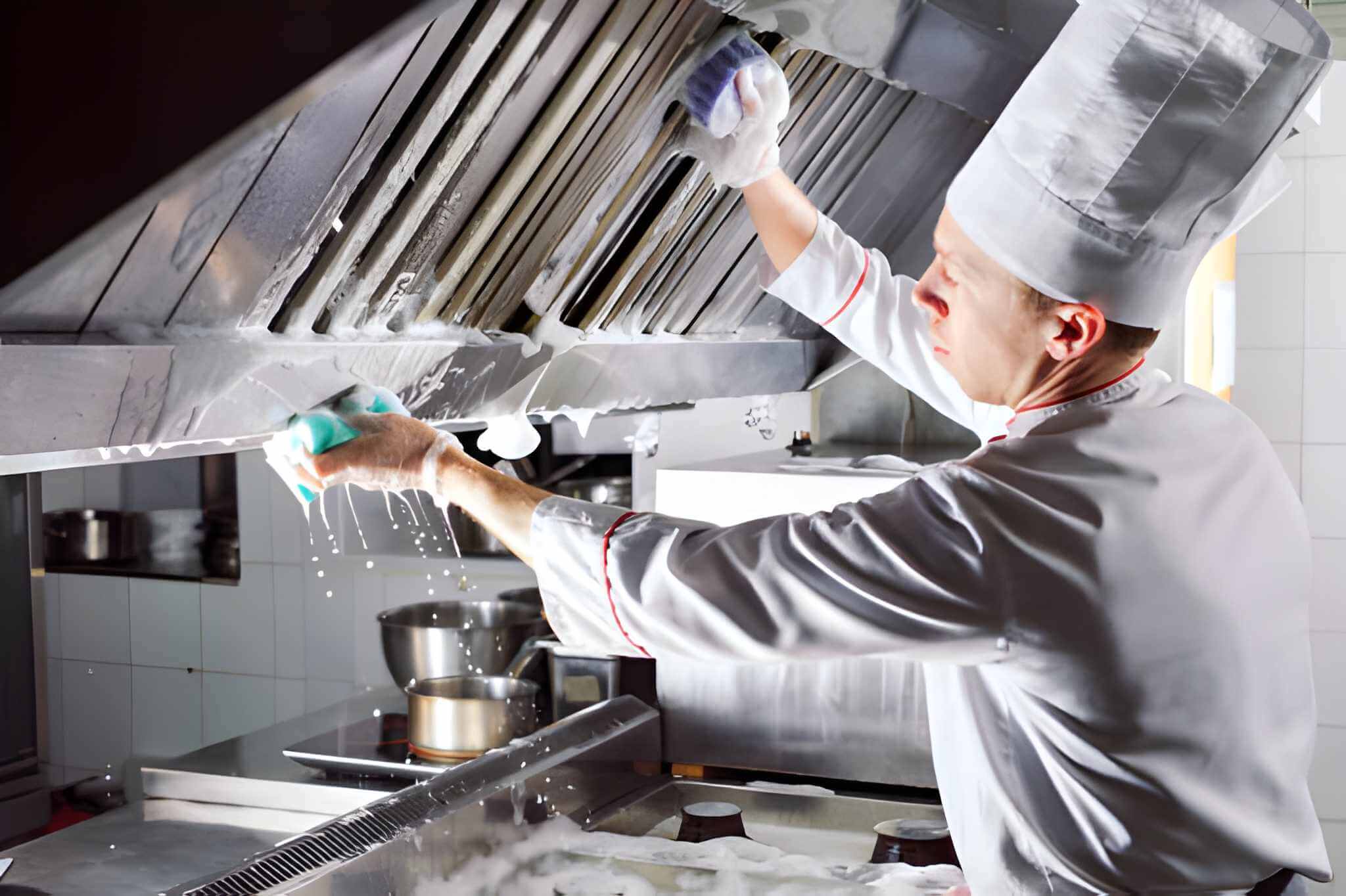
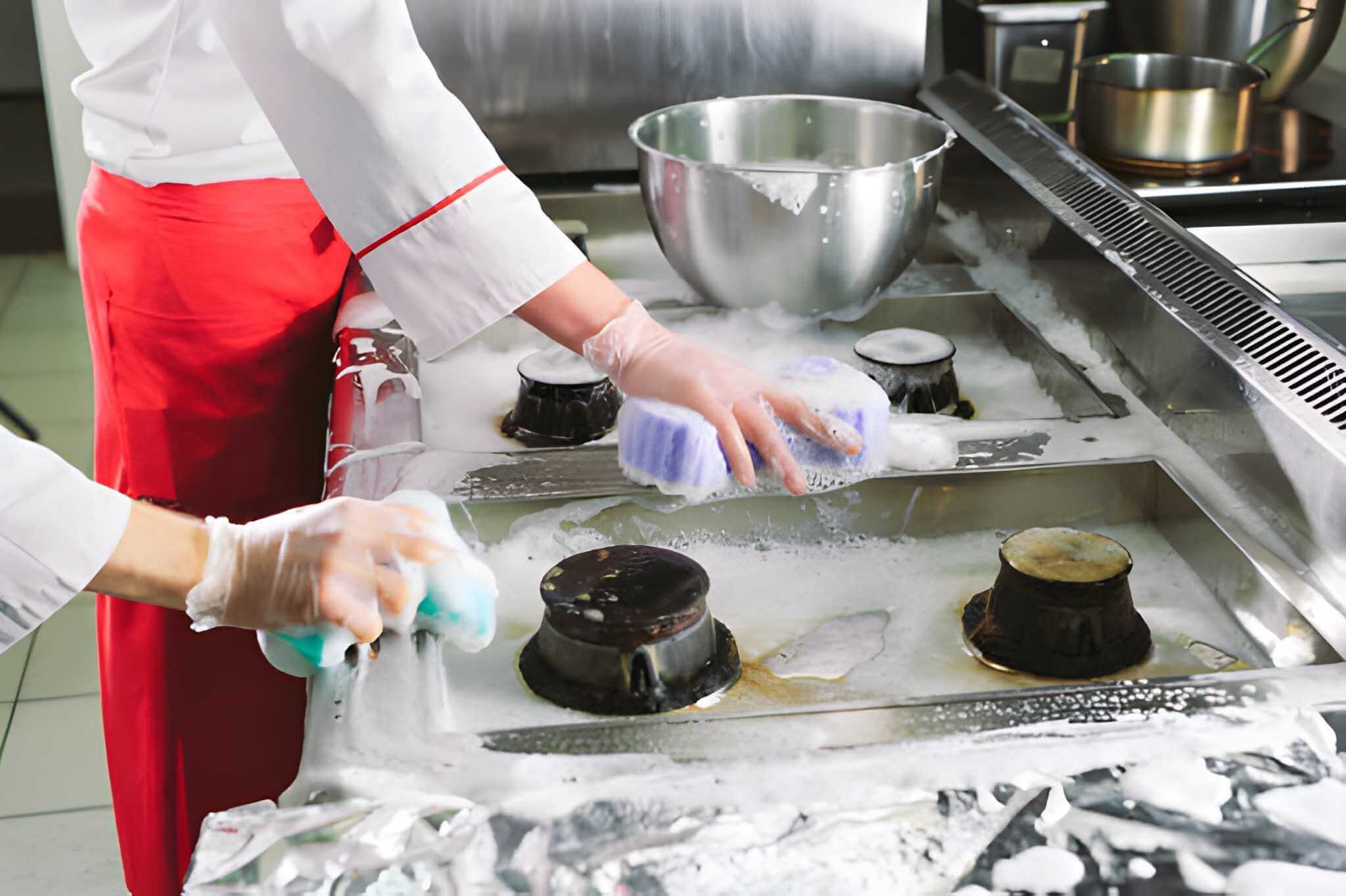
- Range, flat top and burner degreasing: Grates, burner bowls, griddle surfaces, carbon removal and backsplashes, taken back to metal rather than wiped to looking acceptable.
- Fryer surround and boil-out support: Kettle exterior, cabinet, filtration area and the floor and wall behind, with boil-out coordinated to your equipment’s procedure.
- Oven, salamander and broiler exteriors: Exterior degreasing, door glass, handles and the surrounding structure.
- Removable hood baffle filters: Filters removed, washed, degreased and refitted. What happens above the filters is a different question and is answered in the boundary section.
- Wall, ceiling tile and FRP panel degreasing: The grease film above the line that inspectors look for and that ordinary cleaning never reaches.
- Equipment casters, legs and the floor beneath: Line equipment moved where it is safe to do so and the floor and wall behind cleaned, which is where the real findings live.
Cold storage, prep and dish
- Walk-in cooler and freezer interiors: Shelving, racking, gaskets, coved base, floor and ceiling, with gaskets cleaned rather than replaced since replacement is a service call.
- Reach-in cooler interiors and exteriors: Shelves, seals, handles and the compressor grille, which is the most-missed surface in any kitchen.
- Prep tables and cutting board surfaces: Stainless surfaces, undersides, shelving beneath and the wall behind, sanitised to a stated method.
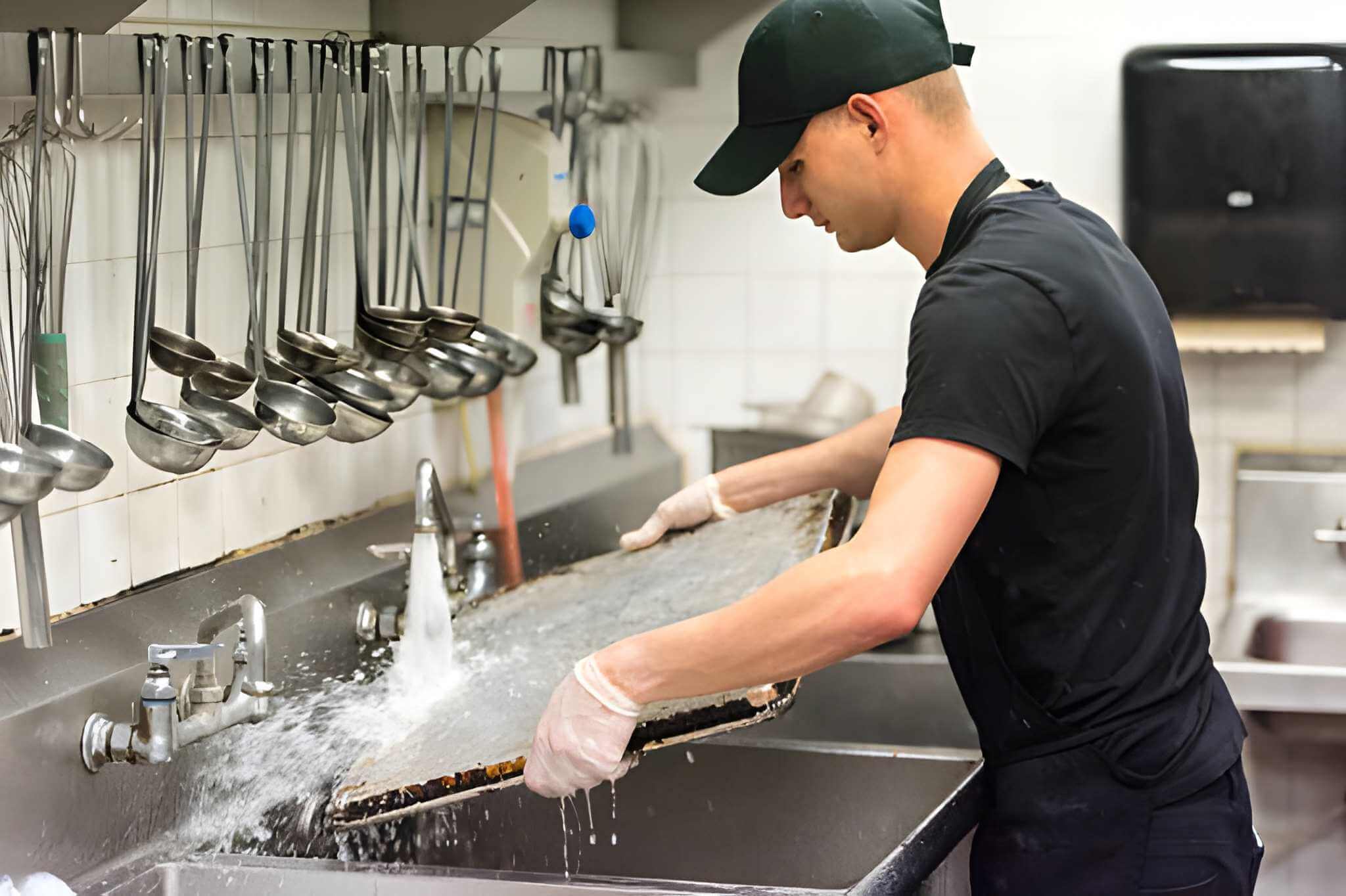
- Dish pit deep cleaning: Three-compartment sink, drainboards, dish machine exterior, splash zones and the wall and floor around them.
- Dry storage and shelving: Wire shelving washed, floor and baseboards cleaned, and the corners where pest activity starts.
- Mop sink and janitorial closet: The one area every inspection reaches and no kitchen crew wants to do.
Floors, drains and waste
- Quarry tile deep scrubbing: Machine scrubbing and grout-line degreasing across the cook line and dish pit, which is the difference between a clean floor and a floor that just looks mopped.
- Floor drain cleaning: Drains cleaned and flushed on a set cycle. Grease interceptor pump-out is a separate, licensed activity, described below.
- Trash and recycling area, dumpster corral: The waste area, the route to it and the corral itself, which is where a pest problem usually originates.
- Exhaust fan housing exteriors: Exterior surfaces only. The interior of the fan and the duct are FDNY-certified scope.

Three Boundaries, Stated Plainly
The hood. In New York City, cleaning a commercial cooking exhaust system requires a technician holding an FDNY Certificate of Fitness W-64 or P-64, and that technician must be employed by an FDNY-approved commercial cooking exhaust system servicing company. It is not a credential an individual can hold independently. FDNY’s own public guidance is explicit that all cleaning of the exhaust system ducts and other components above the hood must be performed by employees of FDNY-approved companies. So the line we draw is at the hood: we remove, wash and refit your baffle filters and we degrease the hood’s accessible interior and exterior surfaces. Ductwork, the plenum above the hood, the fan and the rooftop components require an FDNY-approved company, and that firm also places the service decal and reports deficiencies.
The grease trap. Routine drain cleaning and kitchen degreasing is our work. Pumping out and disposing of a grease interceptor is not: that waste has to leave through a licensed and permitted waste hauler, and in New York City installation of a grease interceptor is itself restricted to a licensed master plumber. Practical maintenance guidance is that fats, oils, grease and solids should not exceed roughly a quarter of the interceptor’s liquid depth, which means the pump-out interval is driven by your volume rather than by a calendar. We keep the drains and the surrounding area clean and we will tell you when the interceptor looks due, but we do not pump it.
The ice machine. We clean the exterior and the area around it. We do not put janitorial chemistry inside an ice machine. Interior bin and evaporator sanitising should follow the manufacturer’s procedure and is properly done by the equipment service technician, because the wrong product in an ice machine is a food safety incident rather than a cleaning shortcut.
One more note on a claim seen across this SERP. NFPA publishes standard 96 for commercial cooking operations; it does not certify companies, so ‘NFPA 96 certified’ is not a real credential. NFPA 96 does set cleaning frequencies tied to how heavily a kitchen is used, and those frequencies are the ones an FDNY-approved company will work to. We reference the standard rather than claiming to be certified by it.
Why Greencap Cleaning
The boundaries are in the quote
Hood, grease trap and ice machine limits are stated before you sign, not discovered when something goes wrong. In a trade where the wrong claim carries a fire code exposure, that is worth more than an extra line item.
Grease work is priced as its own job
Degreasing a cook line is not general cleaning at a higher frequency. It needs different chemistry, different dwell time and different labour, and we quote it that way rather than folding it into a nightly rate that cannot fund it.
Scheduled to the only window that exists
Between close and prep is a narrow slot and it does not move. We size the crew to finish inside it, with the kitchen returned service-ready rather than still wet.
Brooklyn-based, which matters at two in the morning
Our base is on 63rd Street. A crew that is already in the borough can take the late window without a premium and can come back if a deep clean runs into prep.
Call (718) 687-4294 or request a walkthrough with Greencap Cleaning.
(718) 687 4294
How We Work
Not at two in the afternoon. A kitchen at close shows you the real grease load, the actual floor condition and how much room the crew will have, and it tells you honestly how long the job takes.
Nightly kitchen closing work belongs to your team. Periodic deep cleaning, degreasing, walk-ins, filters and floor scrubbing belong on a dated schedule. Mixing the two into one price is how deep cleaning quietly stops happening.
We identify your exhaust system, your interceptor and your ice machine, name what we will and will not do to each, and where a boundary means you need another vendor we say who.
Chemistry applied and given dwell time, top down from hood surfaces and walls to equipment to floor, so soil moves in one direction and the floor is cleaned once rather than three times.
Everything refitted, filters back, equipment repositioned to its marks, floor dried and drains flushed. A kitchen that has to be reassembled by the morning prep cook has not been cleaned, it has been disrupted.
A dated record of what was cleaned and when. When an inspector asks how often the walk-in is deep cleaned, a schedule with dates on it is the answer that ends the conversation.

What a Brooklyn Kitchen Is Actually Working With
Most Brooklyn kitchens are small, and many are in basements. That single fact changes the job: equipment is tight against walls with no room to pull out, the walk-in is often down a further flight, ventilation is limited so degreasing chemistry lingers, and everything the crew brings in comes down a narrow stair. Crew size is capped by floor space rather than by the size of the job, which is why a deep clean in a Brooklyn kitchen takes longer than the same square footage in a suburban restaurant.
The inspection picture is specific too. New York City posts letter grades based on inspection points: zero to thirteen points is an A, fourteen to twenty-seven is a B, twenty-eight or more is a C, and the card has to be posted within five feet of the entrance, four to six feet off the ground, on a front window, door or outside wall where passers-by can see it. Article 81 of the City Health Code requires floors, walls, ceilings and non-food-contact surfaces to be kept free of accumulated dust, dirt, food residue and grease and cleaned as necessary, and it requires pest management to be contracted to a New York State licensed pest management professional, which is another boundary worth knowing sits outside a cleaning contract.
And then there is waste. A commercial kitchen in this city cannot use city collection: it must contract a private carter, and the commercial waste zone programme has been phasing zone-by-zone across the boroughs, which changes who that carter can be depending on your address and the date. It is not our contract, but it affects where waste sits and when, which is very much our problem.
Who We Help
This page is for restaurant owners, executive chefs, general managers and facilities managers responsible for back-of-house condition in Brooklyn and across New York City. Front-of-house dining room cleaning is covered on our restaurants and industrial kitchens page.
Independent restaurants
One kitchen, a tight window, and a deep clean that has to fit between close and prep.
Multi-location groups
Where a consistent standard and a dated record across sites matter more than any single visit.
Commissary and ghost kitchens
Shared production space with multiple operators, where scope boundaries between tenants have to be explicit.
Bakeries and food manufacturers
Ovens, mixers, flour dust and drains, often on a production rather than a service schedule.
Catering kitchens and event venues
Intense use in bursts, with long gaps that are the right window for deep work.
Institutional kitchens
School, campus, hospital and care facility kitchens working to an inspection regime and a fixed calendar.
Serving All Five Boroughs
We clean commercial kitchens across Brooklyn, Manhattan, Queens, the Bronx and Staten Island. Restaurant groups with sites in several boroughs can run one scope and one dated deep-clean calendar, which is what makes a consistent standard across locations achievable rather than aspirational.
Frequently Asked Questions (FAQs)
Do you clean kitchen hoods and exhaust ducts?
We clean the removable baffle filters and the accessible hood surfaces. We do not clean the ductwork, the plenum above the hood, the exhaust fan or the rooftop components. In New York City that work requires a technician holding an FDNY Certificate of Fitness W-64 or P-64 who is employed by an FDNY-approved commercial cooking exhaust system servicing company, and FDNY’s public guidance states that all cleaning of ducts and components above the hood must be done by employees of an approved company. That firm also places the service decal on your system. We will happily coordinate our schedule around theirs.
Who cleans the hood filters versus the duct, and is that the same company?
Usually not, and that is the confusion this whole section exists to clear up. Filter washing is routine kitchen cleaning and sits comfortably in a general cleaning contract. Duct, plenum and fan cleaning is regulated work restricted to FDNY-approved companies with certified technicians. Some kitchens use one vendor for everything by hiring an approved company for the whole job; most use a cleaning contractor for the kitchen and an approved exhaust firm for the system above the hood. Either arrangement is fine as long as nobody is pretending the second job is covered when it is not.
How often should a commercial kitchen hood be cleaned?
NFPA 96, the standard for commercial cooking operations, ties frequency to how the kitchen is used, with solid fuel cooking on the shortest interval and low-volume operations on the longest, and high-volume kitchens sitting in between. Because NFPA 96 is a copyrighted standard that is periodically revised, we would rather your FDNY-approved exhaust company confirm the current interval for your specific system than quote a table from a third-party website. What we can tell you is that filter washing should be far more frequent than system cleaning, and in a busy kitchen that is weekly or better.
Does grease trap cleaning require a licensed company?
The pump-out and disposal does. Grease interceptor waste has to be removed by a licensed and permitted waste hauler, and in New York City the installation of a grease interceptor may only be performed by a licensed master plumber. General guidance is that fats, oils, grease and solids should not be allowed to exceed roughly a quarter of the interceptor’s liquid depth, so the interval depends on your volume rather than a fixed schedule. Our crew cleans your floor drains and keeps the area around the interceptor clean, and will tell you when it looks due, but we do not pump it out.
Can you work around our opening and closing hours?
Yes, and it is normally the only workable arrangement. Most of this work happens between close and prep, which in Brooklyn often means starting after midnight. We size the crew to finish inside your window with the kitchen reset and the floor dry, because a kitchen that is still wet at prep time is a slip hazard and a delayed service. For a multi-day deep clean we sequence it so the kitchen is functional every morning.
What do you do about the waiting room toys and soft seating?
We handle them on a stated protocol rather than pretending they are not there. Hard plastic play items are washable and get disinfected on a set frequency. Soft toys, fabric books and plush items cannot be disinfected reliably and we will tell you so rather than wipe them and call it done. Upholstered seating is vacuumed on every visit and extracted on a periodic cycle. If you want the play area simplified to items that can actually be cleaned, we will say which ones those are.
Will this help our health inspection grade?
It addresses a large share of what points get assigned for. New York City posts letter grades from inspection points, with zero to thirteen points earning an A, and Article 81 of the City Health Code requires floors, walls, ceilings and non-food-contact surfaces to be kept free of accumulated dust, dirt, food residue and grease. Deep cleaning targets exactly those surfaces plus drains, walk-ins and the areas behind and beneath equipment. It will not address food handling practice, temperature control or structural defects, and it is not a substitute for pest management, which the Health Code requires be contracted to a New York State licensed pest management professional.
How much does commercial kitchen deep cleaning cost in Brooklyn?
It is priced by the job rather than the square foot, because the variables that drive labour are the grease load, the equipment count, how much of it can be moved, and how tight the window is. A small basement kitchen with a heavy fryer programme can take longer than a larger kitchen at street level with a lighter menu. We quote after an end-of-service walkthrough, and we would rather quote the real number than a low nightly rate that cannot fund the degreasing labour the job needs.
Get Started
Greencap Cleaning serves commercial and institutional clients across all five boroughs from a base in Brooklyn. Call (718) 687-4294 or request a walkthrough to talk about commercial kitchen cleaning. We will tell you what the job actually involves, including the parts that are not ours to do.
(718) 687 4294