
Showroom Cleaning in NYC
Display-floor cleaning for auto, furniture, appliance, lighting and design showrooms, with the merchandise boundary agreed in advance.
A showroom is a room whose entire job is to make expensive objects look good, which makes cleaning it a different problem from cleaning an office. The glass has to be genuinely streak-free under display lighting that is designed to reveal every flaw, the floor has to hold a finish without swirl marks, and the crew has to know precisely what it may and may not touch on the merchandise. Greencap Cleaning cleans commercial space across all five boroughs. This page covers showrooms of every kind: auto, furniture, appliance, kitchen and bath, lighting, flooring and design-trade, because the surface-care problem is the same even when the product is not.
What's Include
Glass, light and reflective surfaces
- Streak-free glass and partition detailing: Interior display glass, glass partitions, vitrines and entry glazing, cleaned to be inspected under display lighting rather than under office fluorescents.
- Mirror and chrome detailing: Mirrors, chrome trim and polished metal fixtures cleaned with a method that does not leave micro-scratching, which under a spotlight is worse than the dust it replaced.
- Display lighting and track fixtures: Track heads, pendants and fixture housings dusted on a rotation, because dusty fixtures dim the entire room by a noticeable margin.
- High-gloss surfaces without swirl marks: Glossy tile, lacquered fixtures and polished cabinetry cleaned with pad and chemistry chosen for the finish. The wrong pad on a gloss surface is permanent.
Floors
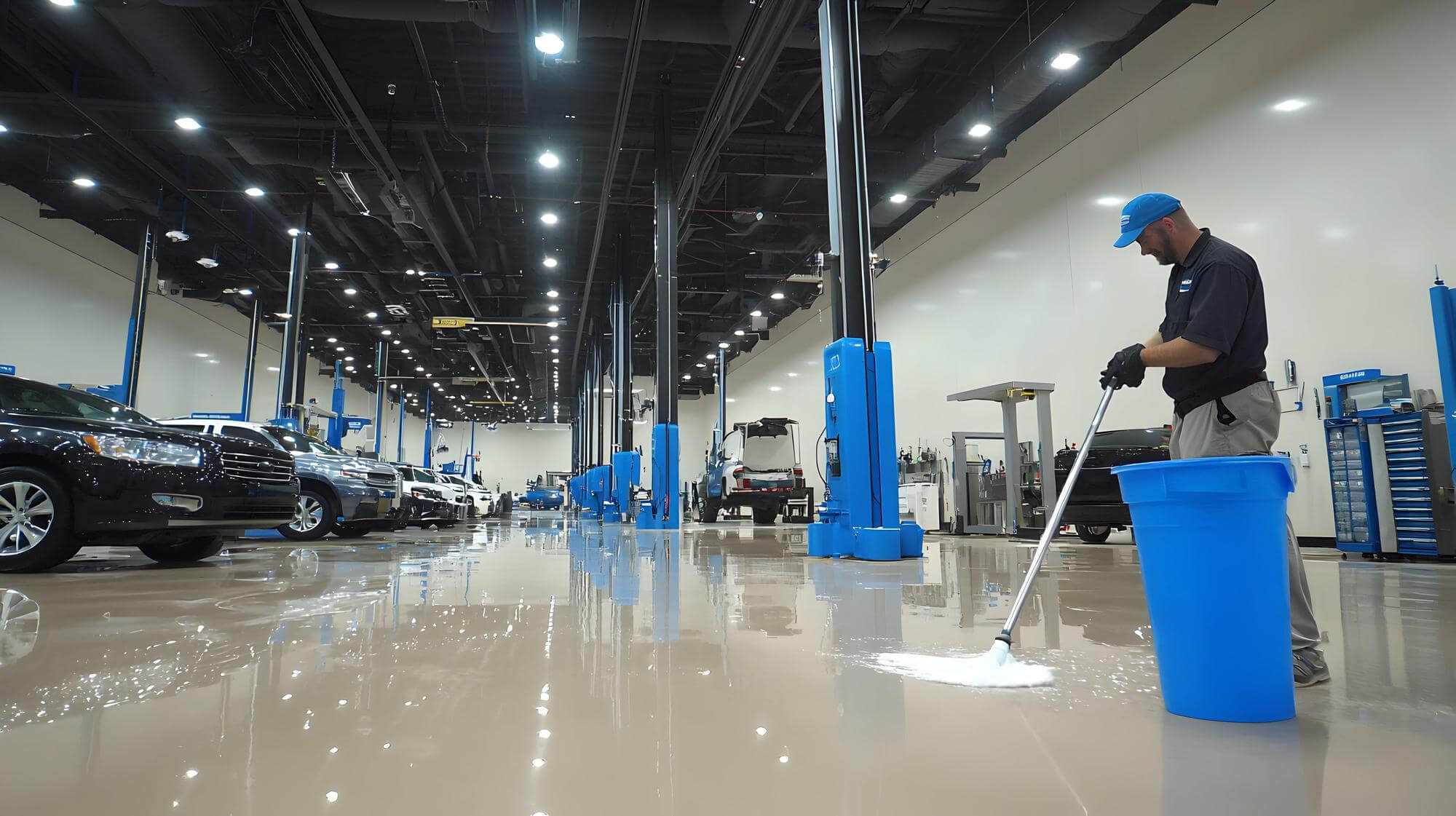
- Polished concrete auto-scrubbing and burnishing: The default auto and design-showroom floor, maintained to hold its gloss rather than dulled by a general-purpose cleaner.
- Porcelain and ceramic tile care: Grout-safe chemistry with no film build-up, because film on a large tile floor shows as a haze exactly where the light hits.
- Hardwood display floor care: pH-neutral only, no water pooling, and a method agreed with your flooring supplier where the floor is itself part of the merchandise.
- Buffing scheduled around trading hours: Floor work timed to before opening or after closing, including the extended hours a showroom keeps at weekends.
Merchandise areas and boundaries
- Display unit dusting to an agreed line: We dust around and beneath display pieces. What our crew may touch on the merchandise itself is agreed in writing before the first shift, and it differs between a sofa, a vehicle and a lighting fixture.
- Vehicle-adjacent cleaning for auto showrooms: Floors, glass, stands and the area around each vehicle. Vehicle exteriors, interiors and tyre dressing are detailing work and sit outside this scope unless separately contracted.
- Service and delivery bay boundary: The janitorial scope ends at the showroom threshold. Bay degreasing, if you want it, is a separate line item with different equipment and different chemistry.
- Vignette and staged-room resets: Furniture and kitchen showrooms staged as rooms need resetting as well as cleaning, and we agree which is our job and which is your sales team’s.
Front of house and exterior
- Customer lounge and refreshment area: Seating, tables, coffee station and the glassware or cups, on a frequency matched to footfall rather than to a nightly pass.
- Restroom detail cleaning: The highest-frequency item across every competitor in this SERP, and correctly so: a showroom restroom does more damage to a sale than a dusty display.
- Entry glass, door tracks and thresholds: The sliding-door track that fills with grit is the detail that separates a cleaned entrance from a maintained one.
- Exterior sidewalk and entryway: Frontage swept, including the 18 inches from the kerb New York City requires property owners to clean, plus litter and debris.
- Seasonal wet-weather matting programme: Matting checked and swapped on an escalating frequency through rain and winter salt season. No competitor on this SERP runs matting as a scheduled programme, and it is the single largest cause of a bad-looking showroom floor.





The Merchandise Line, and Why One Page Covers Every Showroom Type
The question that decides whether a showroom cleaning contract works is not what gets cleaned, it is what the crew may touch. A cleaner who dusts a display sofa the way they would dust a desk can mark the fabric. A cleaner who wipes a vehicle can leave swirl marks on paint that costs more to correct than a year of cleaning. A cleaner who touches a lighting fixture’s shade can bend it.
So we set the line in writing, item type by item type, before the first shift. In an auto showroom the usual line is that our crew cleans everything except the vehicles. In a furniture showroom it might be that hard surfaces and glass are ours and upholstery is not, or that upholstery vacuuming is ours on a stated schedule with a stated tool. In a lighting showroom the fixtures are almost always out of scope. None of this is complicated, but it has to be decided by you rather than assumed by a crew member at nine at night.
The second thing worth saying is why this page covers auto, furniture, appliance, lighting, flooring and design-trade showrooms together when the market treats them separately. It is because the actual cleaning problem is the same: large expanses of glass under revealing light, a floor that has to hold a finish, reflective surfaces that punish the wrong technique, and merchandise the crew must not damage. The product differs and the surface-care discipline does not. Every page ranking for this term is either purely automotive or purely retail showroom, and the split is a marketing artefact rather than an operational one.
Third, matting. Every competitor mentions entrance mats. Not one treats them as a programme. In New York City a showroom’s floor is destroyed by weather more than by traffic, and the fix is not more buffing, it is enough matting at the right depth, checked and swapped at a frequency that rises with the forecast. We run it as a scheduled service with a winter salt phase, and it costs less than the floor restoration it prevents.
Why Greencap Cleaning
Glass and gloss are the whole assignment
A showroom is judged on its reflective surfaces under display lighting. We spec the tools and the technique for that condition rather than applying an office glass method to a wall of vitrines.
The no-touch list is written before we start
What our crew may and may not touch on merchandise is agreed item type by item type, so nobody is making a judgement call about a fifty thousand dollar object at nine at night.
One contractor across showroom types
Dealer groups and design-district operators frequently run more than one showroom format. The surface-care discipline transfers, so one scope and one crew standard can cover all of them.
Floor care sized to weather, not to a calendar
Matting frequency escalates with the forecast and the salt season, which is the cheapest way to protect a display floor in this city.
Call (718) 687-4294 or request a walkthrough with Greencap Cleaning.
(718) 687 4294
How We Work
We walk the showroom with the display lighting on, because that is the only condition in which the glass and gloss standard can actually be judged. A showroom that looks clean under work lights is not the deliverable.
Item type by item type, we record what the crew may dust, what it may vacuum, what it may only work around, and who to call when something needs moving. This document is the contract's most important page.
Showrooms routinely run three or four substrates in one room: polished concrete in the display area, tile at the entry, hardwood in a vignette, carpet in the lounge. Each gets its own method, and we name which is which.
Mat depth, placement and swap frequency are fixed at the start, with an escalated wet-weather and salt-season schedule. This is scheduled, not reactive.
Glass, floors and buffing run before opening or after closing, so the room is presentation-ready at the moment doors open rather than being worked on in front of customers.
The supervisor's final check is done from the customer's entry point looking in, under display lighting, which is how the room will actually be seen.


Showrooms in This City Have a Weather Problem
A showroom in a suburban auto mall has a car park and a covered entrance. A showroom on a New York City street has a sidewalk, and everything on that sidewalk comes inside on people’s feet. Rain brings grit, winter brings calcium chloride and rock salt, and both of them attack a display floor faster than any amount of footfall. Salt residue in particular leaves a white bloom on polished concrete and dulls a hardwood finish, and by the time it is visible the damage has begun.
That is why the matting programme on this page is not a filler item. Adequate matting depth at the entry, checked and swapped on a rising frequency through the season, removes most of what would otherwise be ground into the floor. It is unglamorous and it is the highest-return line in a showroom cleaning contract.
The other New York constraint is the trading day. Showrooms here keep long hours, often seven days, which compresses the off-hours window that glass and floor work require. Auto showrooms are frequently open until eight or nine, and design-trade showrooms surge around market weeks when the room has to look perfect on consecutive mornings. We plan the periodic floor work around those peaks rather than into them.
Who We Help
This page is for dealer principals, general managers, showroom managers and facilities managers responsible for a display environment in New York City. If your site is primarily a service operation rather than a display floor, the auto dealership page covers the service side.
Auto and motorcycle dealerships
A display floor, a customer lounge, and a service side with a clear boundary between them.
Furniture and home furnishings showrooms
Staged vignettes, mixed floor substrates, and upholstery that needs an agreed handling rule.
Appliance, kitchen and bath showrooms
Stainless, glass and high-gloss cabinetry, all of which show every technique error.
Lighting showrooms
Where the fixtures are the merchandise and are almost always out of scope, and where dust on the display is instantly visible.
Flooring and tile showrooms
Where the floor is the product and must be cleaned to the manufacturer’s method rather than ours.
Design-district trade showrooms
Long trading hours, market-week surges, and a standard set by designers rather than by consumers.
Serving All Five Boroughs
We clean showrooms across Manhattan, Brooklyn, Queens, the Bronx and Staten Island. Dealer groups and multi-format operators running more than one showroom can hold every site on a single scope, which is how a consistent presentation standard actually gets enforced across locations.
Frequently Asked Questions (FAQs)
How often should a showroom be professionally cleaned?
Daily for the surfaces customers see, which means glass, entry, floors, lounge and restrooms, because a showroom’s presentation resets every morning. The periodic work sits on a separate schedule: floor burnishing weekly or fortnightly depending on the substrate and the traffic, deep glass and high dusting monthly, and floor restoration annually or on condition. In practice most showrooms need a nightly service plus a day porter presence during trading hours, since the entry and restrooms will not stay presentable for a nine-hour day on an overnight clean alone.
What will your crew touch on our merchandise?
Whatever you agree to and nothing else. We produce a no-touch list at the walkthrough that goes item type by item type: what may be dusted, what may be vacuumed, what the crew works around only, and who to call if something needs moving. In an auto showroom the default is that our crew cleans everything except the vehicles. In a furniture showroom the line is usually drawn between hard surfaces and upholstery. We would rather have this conversation once at the start than have a crew member making a judgement call about an expensive object in the middle of the night.
Do you detail the vehicles?
No. Vehicle exteriors, interiors and tyre dressing are detailing work with different products, different equipment and different insurance, and they belong to your detail department or a detailing contractor. We clean the showroom floor, the glass, the stands and the area around each vehicle, so the room presents well and the cars themselves are handled by people who do that for a living.
How do you handle delicate floor surfaces like polished concrete or hardwood?
By identifying each substrate before quoting and assigning a method to each. Polished concrete is auto-scrubbed and burnished to hold its gloss. Porcelain and ceramic take a grout-safe product that does not build a film. Hardwood is cleaned pH-neutral with no water pooling, and where the floor is itself part of the merchandise we will work to your flooring supplier’s stated method rather than ours. Most showroom floor damage comes from a single programme being applied across three substrates, and it is not always reversible.
Can cleaning be scheduled after business hours?
Yes, and the visible work should be. Glass, floors and buffing run before opening or after closing so the room is ready at the moment doors open. In showrooms trading until eight or nine that window is narrow, so we size the crew to it. Where a room needs presence during the day as well, a day porter covering entry, restrooms and lounge costs far less than trying to hold a nine-hour standard on an overnight clean.
Do you clean showrooms other than auto dealerships?
Yes, and deliberately so. Furniture, appliance, kitchen and bath, lighting, flooring and design-trade showrooms all present the same cleaning problem: large glass expanses under revealing light, a display floor that has to hold a finish, reflective surfaces that punish the wrong technique, and merchandise the crew must not damage. The product changes and the discipline does not. Most vendors treat automotive and retail showrooms as separate businesses, which is a marketing division rather than an operational one.
Can you provide extra cleaning during market weeks or a model launch?
Yes, and it should be planned rather than called in. Market weeks, model launches and trade events mean the room has to look perfect on consecutive mornings and often needs mid-day attention too. We build surge coverage into the annual plan with the dates named, which is both cheaper and more reliable than arranging additional crews at short notice during the week everyone else needs them.
Is it better to hire a contractor or keep an in-house cleaner for a showroom?
It depends on the hours and the periodic work. An in-house person can hold a good daytime standard and is genuinely useful for a busy showroom floor. What they usually cannot do is the periodic work: floor burnishing and restoration, deep glass, high dusting and matting management, all of which need equipment and a second pair of hands. A common arrangement that works well is your own daytime presence plus a contracted overnight and periodic programme, and we are happy to quote that split rather than pushing for the whole thing.
Get Started
Greencap Cleaning serves commercial and institutional clients across all five boroughs from a base in Brooklyn. Call (718) 687-4294 or request a walkthrough to talk about showroom cleaning. We will tell you what the job actually involves, including the parts that are not ours to do.
(718) 687 4294