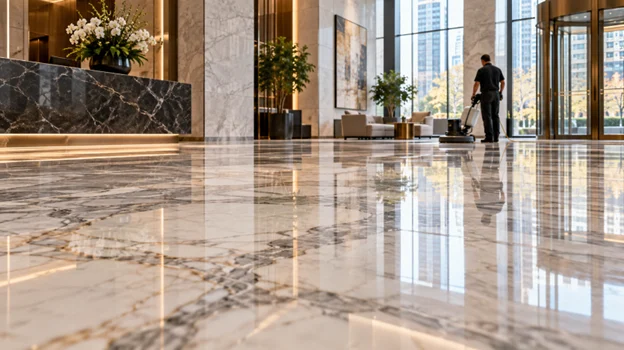
Honing grinds the marble with diamond abrasives to remove scratches and etch marks, polishing refines that surface until it reflects light, and crystallization uses a chemical reaction under a floor machine to harden and shine the top layer. Most worn NYC lobby floors need honing first, then polishing to the finish the building wants, then a maintenance routine that stops the damage from coming back.
The wrong process is expensive to undo. A crystallized layer, for example, can only be removed by honing it off. Before you approve a quote for marble floor polishing, it helps to know what each method does, what it cannot fix, and why winter in New York is the hardest season on stone.
Why Marble Floors Lose Their Shine
Marble is mostly calcium carbonate. That makes it beautiful and relatively soft, and it reacts with acids. Four things dull a lobby floor:
- Grit. Sand and street dirt tracked in on shoes act like sandpaper. The Natural Stone Institute recommends mats inside and outside entrances and frequent dry dust mopping for exactly this reason.
- Etching. Acids such as coffee, juice, vinegar and many general-purpose cleaners dissolve the polished surface and leave dull marks. Etching is surface damage, not a stain, and cleaning will not remove it.
- Salt and ice melt. Winter brings abrasive crystals and a residue that clouds the finish.
- Traffic lanes. The path from the door to the elevator wears first and shows first.
One rule applies to every marble floor: never wax it. Wax and acrylic finishes belong on vinyl and VCT, which our floor finishing and waxing service handles. On stone they trap dirt, yellow and make the eventual restoration harder.
Honing, Polishing and Crystallization Compared
Unsure which process you need? Request a floor assessment and ask to see a test area before approving lobby-wide work.
| Honing | Polishing | Crystallization
————————————————— | ———————————————————- | ——————————————————————– |
| What it is | Grinding with diamond abrasive pads, coarse to fine | Final passes with very fine abrasives or polishing powders | A chemical treatment buffed in with steel wool under a floor machine |
| What it fixes | Scratches, etch marks, lippage, worn traffic lanes | Dullness on a sound surface | Dullness; adds surface hardness |
| Finish | Matte to satin | Satin to high gloss | High gloss |
| Changes the stone? | Removes a thin layer of stone | Refines the existing surface | Chemically alters the top surface |
| Reversible? | It is the reset | Yes, by honing | Only by honing it off |
| Best for | Damaged floors and restorations | Restoring shine after honing | Periodic maintenance on marble, not granite |
Honing
Honing is the only process that removes real damage. A technician works through progressively finer diamond pads until the scratches and etch marks are gone. Stopping at a medium grit leaves a honed, satin surface. Continuing to finer grits prepares the floor for polishing.
Polishing
Polishing brings the reflection back. It is done with very fine diamond pads or polishing powders under a slow-speed machine. On a floor with no deep damage, polishing alone can restore the look. On a scratched floor, polishing without honing first simply gives you shiny scratches.
Crystallization
Crystallization (also called vitrification) applies an acid-based compound that reacts with the calcium in the stone to form a harder surface layer. It gives a fast, high shine and is popular for maintenance, but it has limits worth knowing:
- It works on calcium-based stone such as marble and limestone, not on granite.
- Some products contain wax, and even wax-free versions can build up if used too often.
- The treated layer cannot be stripped with chemicals. Removing it means diamond honing.
- Opinions in the stone trade are divided, so ask any vendor exactly which product they use and why.
Honed or Polished: Which Finish Suits a NYC Lobby?
A polished finish creates a strong reflection and suits lobbies that prioritize shine. It also shows scratches sooner and can feel slick when wet. A honed finish can make everyday wear less noticeable; slip resistance depends on the specific floor and conditions. Many buildings choose a middle ground: a high hone or satin polish in traffic lanes and entries.
If slip resistance is a concern, ask a qualified floor professional to evaluate the surface and conditions. Maintain entry matting and remove tracked-in moisture promptly.
Is your lobby floor dull, etched or worn? Greencap Cleaning hones, polishes and maintains marble and stone floors in lobbies, hotels, showrooms and offices across NYC. Call (718) 687-4294 or request a free floor assessment.
Winter Is the Hardest Season for Marble
Winter can accelerate wear on a lobby floor. Salt crystals scratch, slush carries grit deep into the building, and ice melt residue leaves a white film.
- Lengthen the matting. Use enough walk-off matting for visitors to take several steps before reaching the stone.
- Dust mop more often, at least twice a day on storm days.
- Use a pH-neutral cleaner made for stone to lift salt residue. Do not use acidic salt neutralizers on marble. They are designed for concrete and will etch the finish.
- Coordinate with your porter or super on the ice melt used outside, since whatever goes on the sidewalk ends up on the lobby floor.
Buildings with a day porter can add a mid-shift mop on bad-weather days. Our day porter and matron service covers exactly this kind of daytime floor care.
A Maintenance Schedule That Protects the Finish
| Frequency | Task |
——————————————————————————————– |
| Daily | Dry dust mop the whole floor; damp mop with a pH-neutral stone cleaner; clean entrance mats. |
| Weekly | Machine scrub traffic lanes with a soft pad and neutral cleaner. |
| Monthly to quarterly | Buff or light polish traffic lanes, depending on traffic. |
| Once or twice a year | Full polish; hone first where etching or scratches have built up. |
| As needed | Reseal with an impregnating sealer after honing, based on a water absorption test. |
A sealer makes marble more resistant to staining, not stain-proof, and it does nothing to prevent etching. Daily care matters more than any single restoration. Marble is a common finish in the buildings we serve, from hotel public areas and showrooms to bank branches and residential lobbies. Our apartment building common area checklist shows where floor care sits in a building’s full schedule.
What to Ask Before You Approve a Marble Floor Quote
- Which process, and why? A vendor who proposes crystallization on a scratched floor, or polishing without honing, has not diagnosed the problem.
- Will you do a test area? A small patch shows the finish before the whole lobby is committed.
- How will you protect walls, elevators, and doors? Honing creates a wet slurry that has to be contained.
- How will the lobby stay open? Most buildings need the work done in sections, overnight or on weekends.
- What sealer, if any, and what cleaner afterward? The aftercare decides how long the result lasts.
Final Thoughts
Honing fixes damage, polishing restores shine, and crystallization is a maintenance shortcut with trade-offs. An assessment can identify whether the floor needs honing, polishing, or a lighter maintenance visit. Ask for a test area and a care plan you can use after the work.
Frequently Asked Questions
What is the difference between honing and polishing marble?
Honing uses diamond abrasives to remove scratches and etch marks and leaves a matte to satin finish. Polishing uses finer abrasives or powders to bring back the shine. A damaged floor usually needs honing before polishing.
Is marble crystallization bad for floors?
Not necessarily, but it has limits. It chemically alters the top surface, works only on calcium-based stone, can build up if overused, and can only be removed by honing. Ask the vendor which product they use and why.
How often should a marble lobby floor be polished?
The interval depends on traffic, finish and daily care. Ask for a floor assessment before setting a polishing schedule.
Can you wax a marble floor?
No. Wax and acrylic finishes are made for vinyl and VCT. On marble they trap dirt, discolor and make restoration harder.
How do you remove salt stains from a marble floor?
Use a pH-neutral cleaner made for stone and dust mop frequently. Avoid acidic salt neutralizers, which are made for concrete and will etch marble.
| Ready to bring your lobby floor back?
Greencap Cleaning restores and maintains marble floors across Manhattan, Brooklyn, Queens, the Bronx, and Staten Island. Call (718) 687-4294 or get a free quote. |