Post-construction cleaning is not one job. It runs in three passes, timed against the construction schedule, because dust that has not finished settling cannot be cleaned yet. Trying to compress it into a single visit is the most common reason a space fails its final walkthrough and the turnover date slips.
This checklist covers all three phases, what belongs in each, the room-by-room detail that gets missed, and the New York City building realities that determine when your crew can actually be on site. Whether you are a general contractor closing out a build or a tenant taking delivery of a space, working from the same list keeps the handoff clean.
Why Post-Construction Cleaning Happens in Three Phases
Construction dust is not like ordinary dust. Drywall compound, concrete, and sawdust produce particles fine enough to stay airborne for hours and then settle in waves. Clean a surface while the air is still loaded and it will be visibly dirty again by morning.
The phased approach exists to work with that reality instead of against it. Rough clean removes bulk debris so trades can finish. Detail clean happens after the last dusty trade leaves. Final clean is the presentation pass immediately before handover.
Phase 1: Rough Clean
Timed after the major trades are substantially complete but before finishes go in. The goal is a safe, workable site, not a clean one.
- Remove all bulk construction debris, offcuts, packaging, and scrap
- Remove leftover materials, empty buckets, and abandoned equipment
- Sweep or shop-vacuum all floor areas, including stairwells and mechanical rooms
- Clear debris from window tracks, door frames, and floor channels
- Remove stickers, labels, and manufacturer film from fixtures, glass, and appliances
- Knock down high dust from exposed structure, joists, and overhead runs
- Clean and clear restrooms enough for trade use
- Sort waste for disposal, separating recyclable construction and demolition material
- Broom-finish all hard surfaces so finish trades can work
Note the sorting requirement. Under NYC rules (16 RCNY 1-10), businesses are required to recycle construction waste, and construction and demolition material cannot simply be bagged with general refuse. Building that separation into the rough clean is far cheaper than sorting a mixed pile later.
Phase 2: Detail Clean
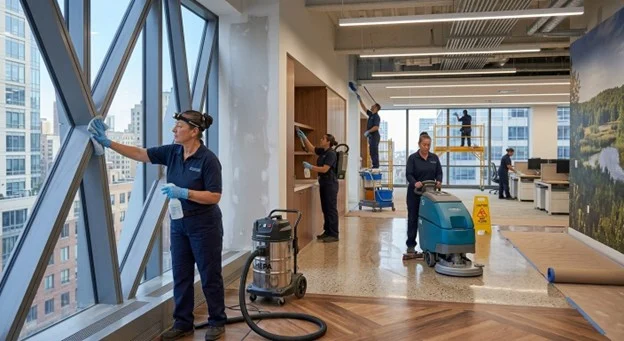
The heaviest phase, and the one that determines whether the space passes inspection. It begins after the last dust-producing trade has left, usually a few days after rough clean so airborne particulate has settled.
- Ceilings down. Vents, diffusers, sprinkler heads, light fixtures, and ceiling tile faces.
- Walls. Wipe all vertical surfaces, remove compound splatter, paint overspray, and adhesive residue.
- Millwork and casework. Inside and outside every cabinet, drawer, and shelf, including the tops nobody sees.
- Doors and frames. Both faces, top edges, hinges, hardware, and the frame reveal.
- Windows. Interior glass, frames, sills, and tracks, with construction residue and stickers removed.
- Fixtures. Switch plates, outlets, thermostats, fire alarm devices, and signage.
- Restrooms. Full detail of fixtures, partitions, mirrors, dispensers, and tile grout.
- Kitchens and pantries. Appliance interiors and exteriors, backsplashes, sinks, and under-counter areas.
- Floors. Vacuum with HEPA filtration, then damp mop or scrub per the flooring manufacturer specification.
- Elevators. Cab interiors, tracks, and door sills, which collect construction grit.
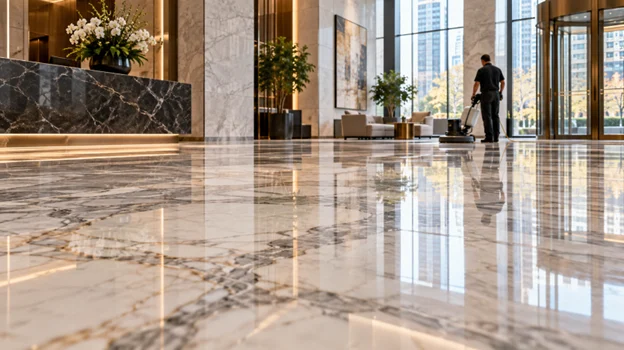
Hard floors installed during the build usually need their initial finish applied at this stage. That is a separate specialty from cleaning, and our floor polishing and buffing team handles the first seal and finish so the surface is protected before occupancy rather than after the first scuff.
| Closing out a build in New York?
Greencap Cleaning runs phased post-construction cleaning across NYC for general contractors, developers, and tenants, scheduled around your freight windows. Call (718) 687-4294 for a project quote. |
Phase 3: Final Clean
The presentation pass, performed as close to handover as scheduling allows. This is a short, high-detail visit that catches whatever settled after detail clean and whatever the punch list crew disturbed.
- Re-dust all horizontal surfaces, including sills, ledges, and casework tops
- Polish glass, mirrors, and stainless steel to a streak-free finish
- Spot-clean walls and doors where punch list work left marks
- Detail restrooms again and stock consumables if required
- Final floor pass, vacuum and damp mop or buff
- Remove all protective floor covering, masking, and corner guards
- Clean entry glass, thresholds, and the exterior approach
- Final debris removal and site walk with the project manager
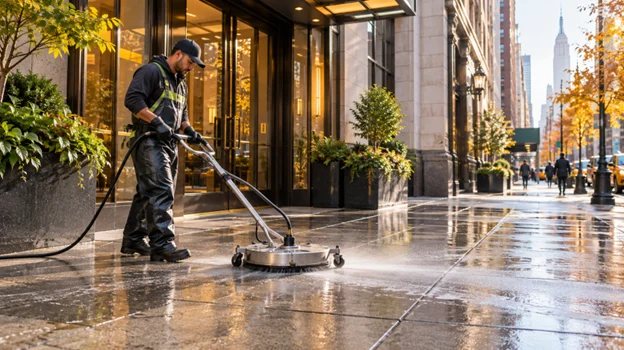
If the project included exterior work, the sidewalk and facade usually need attention as well. Construction leaves dust film, mortar splash, and staining that sweeping will not lift, which is where commercial pressure washing comes in before the first tenant photograph is taken.
The Areas Most Often Missed
| Area | What gets done | What gets missed |
|---|---|---|
| Window tracks and sills | Vacuum then wet detail | Compacted grit in the track corners and the weep holes |
| Door frames | Wipe both faces and hardware | The top edge of the door and the frame head |
| HVAC vents and diffusers | Remove, wash, reinstall | The duct face behind the diffuser and the filter itself |
| Light fixtures | Wipe lens and housing | Dust inside the lens, visible once the lights are on |
| Cabinet interiors | Vacuum and wipe | The cabinet top and the toe kick recess |
| Elevator sills | Vacuum the track | Grit under the sill plate that causes door faults |
| Stairwells | Sweep and mop | Handrails, risers, and the underside of landings |
| Restroom grout | Clean tile faces | Grout haze and compound residue in the joints |
Carpet installed before the final trades finish is a category of its own. It traps fine particulate that vacuuming alone will not lift, and it typically needs professional carpet and upholstery extraction before handover rather than after the first complaint.
The NYC Realities That Change Your Schedule
Everything above assumes the crew can get in and work. In New York, that assumption is usually the constraint:
- Freight elevator windows. Many buildings allocate limited freight hours, and a cleaning crew competes with every other trade for them. Debris removal has to be scheduled, not assumed.
- Certificates of insurance. Buildings require a COI naming the owner and managing agent with specific limits before a crew is admitted. Processing takes days, so it belongs at contract signing rather than the night before.
- After-hours restrictions. Occupied buildings frequently restrict noisy or dusty work to evenings and weekends, which changes crew size and cost.
- Waste handling. Construction and demolition debris requires separation and licensed carting. It cannot go into building compactors or public litter baskets.
- Neighboring tenants. In a partial-floor build, dust migration into occupied space becomes your problem quickly. Containment and negative air management matter as much as the cleaning.
- Loading dock access. Dock scheduling in Manhattan can add a full day to a debris pull if it is not booked in advance.
These are the variables that make a post-construction quote a project price rather than a square footage rate. Two identical build-outs, one in a Manhattan tower and one in a low-rise Brooklyn building, can differ substantially on access alone.
Construction Dust: Why It Keeps Coming Back
The complaint we hear most often is that a space was cleaned, signed off, and looked dusty again within a week. There are usually three causes, and none of them is the cleaning crew.
First, the HVAC system ran during construction. Ductwork now holds fine particulate that redistributes every time the system cycles. Filters need replacing after the build, and in dusty projects the ducts themselves need attention before final clean, not after.
Second, cleaning began before the dust finished settling. Fine drywall particulate can remain airborne for many hours. A detail clean performed the same day as sanding is a detail clean that will need repeating.
Third, standard vacuums were used. Shop vacuums without HEPA filtration exhaust the finest particles straight back into the room, which is why they appear to spread dust rather than remove it. Post-construction work requires HEPA filtration throughout.
Five Mistakes That Delay Turnover
- Booking one clean instead of three. A single visit cannot span the construction sequence, and the result is a failed walkthrough.
- Scheduling detail clean before the punch list. Punch work generates dust and marks. Detail clean should follow it, with final clean after.
- Leaving the COI to the last week. The crew cannot enter the building without it, and processing is not instant.
- Ignoring the HVAC. Filters and ducts carry the dust that undoes everything else.
- Not walking the space with the cleaning supervisor. A ten-minute joint walk before final clean catches the punch items that would otherwise surface in front of the client.
Final Thoughts
Post-construction cleaning sits at the end of the schedule, which means it absorbs every delay upstream and gets blamed for the ones downstream. The projects that close cleanly are the ones where the cleaning contractor was brought in during planning, given the freight windows and the COI early, and scheduled in three passes rather than one.
Use this checklist as the scope document. If your cleaning vendor cannot tell you which phase they are quoting, they are quoting a guess.
Frequently Asked Questions
What are the three phases of post-construction cleaning?
Rough clean removes bulk debris after the major trades finish so finish work can proceed. Detail clean is the comprehensive top-to-bottom pass after the last dusty trade leaves, covering ceilings, walls, fixtures, millwork, and floors. Final clean is a short presentation pass just before handover that catches settled dust and punch list marks.
How long does post-construction cleaning take?
It depends on square footage, the finish level, and building access. The controlling factor in New York is usually not the cleaning itself but freight elevator availability and after-hours restrictions, which can extend a two-day job across a week. Ask for a phase-by-phase schedule rather than a single duration.
Why is my space still dusty after post-construction cleaning?
Usually one of three reasons: the HVAC system ran during construction and is redistributing particulate through the ducts, the cleaning was performed before airborne dust finished settling, or non-HEPA vacuums were used and exhausted fine particles back into the room. Replacing filters and scheduling a second detail pass typically resolves it.
Do I need a certificate of insurance for a cleaning crew in NYC?
Almost always. Most commercial buildings require a COI naming the owner and managing agent, with specified coverage limits, before any contractor is admitted. Request it at contract signing rather than close to the start date, since processing and approval can take several days.
Can construction debris go in the building compactor?
No. Construction and demolition material must be separated and removed by a licensed carter, and NYC rules require businesses to recycle construction waste. Putting it in building compactors or public litter baskets creates a violation exposure for the property.
| Ready to schedule your post-construction clean?
Greencap Cleaning provides phased post-construction cleaning and full commercial cleaning services throughout Brooklyn, Manhattan, Queens, the Bronx, and Staten Island. Call (718) 687-4294 or request a project quote. |